Amina Tayyub
Working on the spectrum between product design & product management to shape experiences grounded in real human needs.
view cv
Amina Tayyub
Working on the spectrum between product design & product management to shape experiences grounded in real human needs.
view cv
Amina Tayyub
Working on the spectrum between product design & product management to shape experiences grounded in real human needs.
view cv
EULAR
Building practice that matches the actual exam environment
Building practice that matches the actual exam environment
Problem
Problem
Students preparing for exams have plenty of material: lecture slides, their own notes, sometimes past papers. What they don't have is a way to find out whether they're ready before the real exam tells them.
Physical past papers make this worse. They are limited in supply, and once a student has worked through what their faculty has released, there is nothing left to practice on.
Students preparing for exams have plenty of material: lecture slides, their own notes, sometimes past papers. What they don't have is a way to find out whether they're ready before the real exam tells them.
Physical past papers make this worse. They are limited in supply, and once a student has worked through what their faculty has released, there is nothing left to practice on.
My Contribution (as product design manager)
My Contribution (as product design manager)
As Lead Product Design Manager, I owned product and UX/UI decisions across the platform, working with one engineer to build it.
As Lead Product Design Manager, I owned product and UX/UI decisions across the platform, working with one engineer to build it.
Context
Context
Physical past papers run out. Once a student has worked through what their faculty has released, there is nothing left to practice on. Eular's bet is that a mock exam only feels worth sitting if it is built from a student's own material, their lecture slides and notes, and aimed at what they specifically do not know yet. Generated exams replace the finite supply of physical past papers with a practice source that does not run out.
North star metric: average exams generated per student per semester. Chosen over sign ups or time in app because a student only generates a second and third exam if the first one was worth sitting. It is the closest single number to the product doing its job.
Physical past papers run out. Once a student has worked through what their faculty has released, there is nothing left to practice on. Eular's bet is that a mock exam only feels worth sitting if it is built from a student's own material, their lecture slides and notes, and aimed at what they specifically do not know yet. Generated exams replace the finite supply of physical past papers with a practice source that does not run out.
North star metric: average exams generated per student per semester. Chosen over sign ups or time in app because a student only generates a second and third exam if the first one was worth sitting. It is the closest single number to the product doing its job.
MVP
MVP
Testing the idea before building the product
Testing the idea before building the product
The first version was deliberately narrow: upload your slides and notes, we extract the concepts, we generate an exam. Nothing else.
Launched at one university, distributed through a few WhatsApp groups. Live for two weeks.
40 sign-ups, 9 paid.
That was enough to validate the core idea and justify building the full product.
The first version was deliberately narrow: upload your slides and notes, we extract the concepts, we generate an exam. Nothing else.
Launched at one university, distributed through a few WhatsApp groups. Live for two weeks.
40 sign-ups, 9 paid.
That was enough to validate the core idea and justify building the full product.
What paying users told us
What paying users told us
We interviewed the 9 students who paid. Three things came up consistently:
- They wanted a proper notes feature, not just an upload box
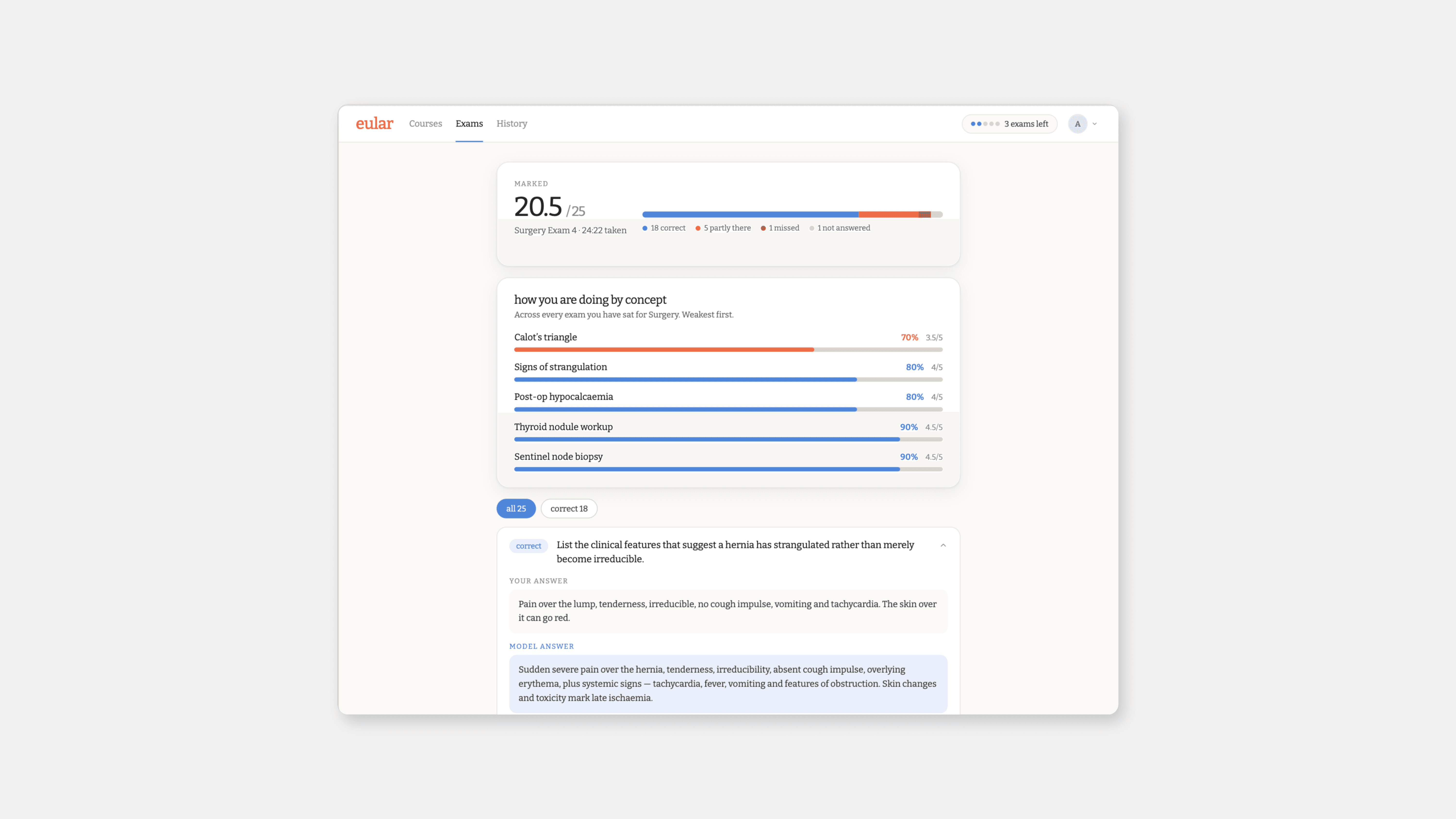
- They wanted to see their progress across exams, not just one score at a time
- They wanted to target specific concepts they were weak in, rather than getting an even spread
All three became core parts of the redesign.
We interviewed the 9 students who paid. Three things came up consistently:
They wanted a proper notes feature, not just an upload box
They wanted to see their progress across exams, not just one score at a time
They wanted to target specific concepts they were weak in, rather than getting an even spread
All three became core parts of the redesign.
Redesign Decisions
Redesign Decisions
Exams generated only from the concepts a student flags as weak
Exams generated only from the concepts a student flags as weak
Students select which concepts they are weak in from a concept picker grouped by topic. The generated exam draws its questions only from those selected concepts, not a broader spread across all material.
The hypothesis is that a student preparing for exams already knows the ground they've covered. What they need practice on is the ground they haven't, and a generic spread across everything wastes their limited exam credits on concepts they don't need to test. This is the product's core differentiation, closer to a coach who studies the actual playing field and drills a player on it, rather than running a generic training session.
Students select which concepts they are weak in from a concept picker grouped by topic. The generated exam draws its questions only from those selected concepts, not a broader spread across all material.
The hypothesis is that a student preparing for exams already knows the ground they've covered. What they need practice on is the ground they haven't, and a generic spread across everything wastes their limited exam credits on concepts they don't need to test. This is the product's core differentiation, closer to a coach who studies the actual playing field and drills a player on it, rather than running a generic training session.

Notes that conflict with slides are shown side by side, not merged
Notes that conflict with slides are shown side by side, not merged
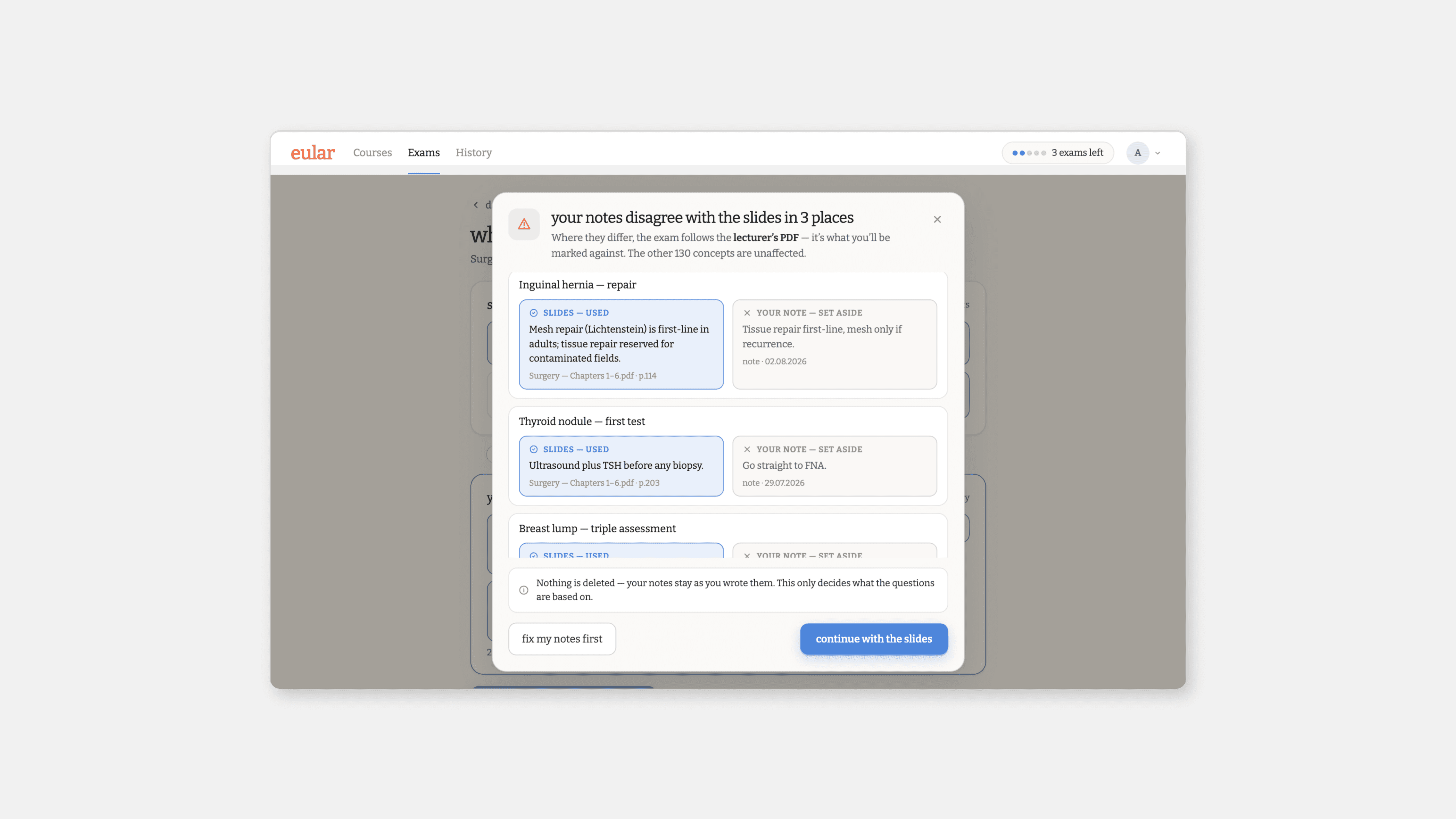
If something a student wrote in their notes conflicts with what is in the slides, both are surfaced rather than one silently overriding the other. The slides are not automatically treated as correct, since a note might reflect something the teacher said in class that never made it onto a slide. But a note is not trusted blindly either. The student sees the conflict and resolves it themselves.
If something a student wrote in their notes conflicts with what is in the slides, both are surfaced rather than one silently overriding the other. The slides are not automatically treated as correct, since a note might reflect something the teacher said in class that never made it onto a slide. But a note is not trusted blindly either. The student sees the conflict and resolves it themselves.
A quality check strips out unanswerable questions
A quality check strips out unanswerable questions
Before an exam reaches the student, a check removes any question the source material cannot actually answer. The product's whole value is that the exam is built from the student's own material. A question that is not backed by that material breaks the promise, even if the question itself is well formed.
Before an exam reaches the student, a check removes any question the source material cannot actually answer. The product's whole value is that the exam is built from the student's own material. A question that is not backed by that material breaks the promise, even if the question itself is well formed.
Sitting an exam is a one-way door
Sitting an exam is a one-way door
Once a student starts a graded attempt, there is a confirmation step, then one attempt with no retakes. This protects what the score means. If a student looked at the answers before sitting, the result is marked as practice rather than a real score, for the same reason.
Once a student starts a graded attempt, there is a confirmation step, then one attempt with no retakes. This protects what the score means. If a student looked at the answers before sitting, the result is marked as practice rather than a real score, for the same reason.
The free exam is a full Pro-tier exam, not a stripped-down one
The free exam is a full Pro-tier exam, not a stripped-down one
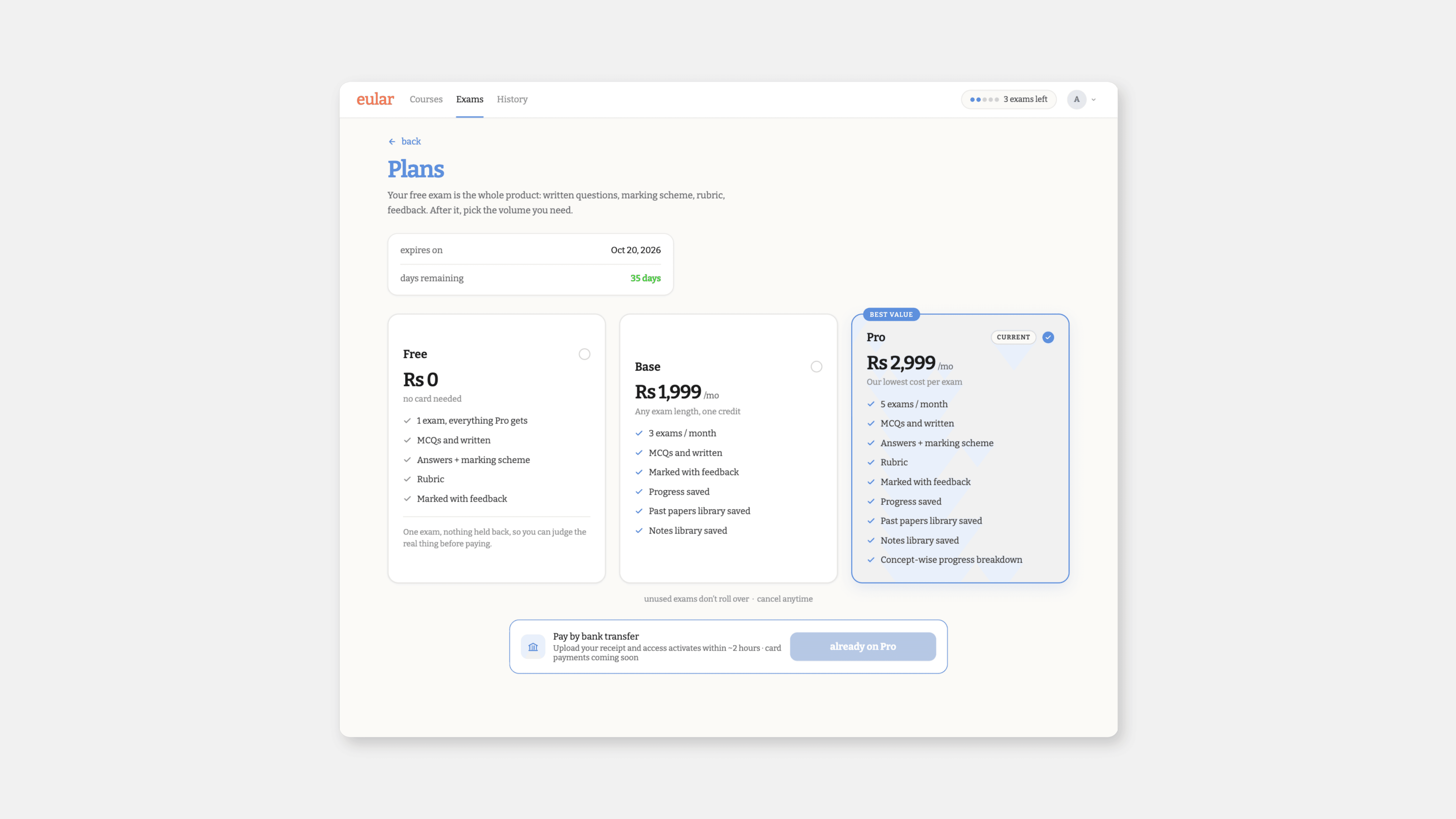
A student's one free exam gives them the complete Pro experience, written questions, marking scheme, rubric, feedback, not a limited MCQ-only version. After that first exam, they choose between Base and Pro. The free tier exists to show the actual value of the product before asking for payment, not to hold back features as a sales tactic. A student who only ever saw a stripped-down free version would have no real basis to judge whether the paid product is worth it.
A student's one free exam gives them the complete Pro experience, written questions, marking scheme, rubric, feedback, not a limited MCQ-only version. After that first exam, they choose between Base and Pro. The free tier exists to show the actual value of the product before asking for payment, not to hold back features as a sales tactic. A student who only ever saw a stripped-down free version would have no real basis to judge whether the paid product is worth it.
Scope Decisions
Scope Decisions
Two built features were deliberately held back rather than shipped:
Teacher-style generation, which would shape questions to match a specific teacher's style, needs a real bank of that teacher's past papers to learn from. The product is still collecting those progressively as students upload their own. Turning this on before there is enough material per teacher would mean shaping questions off too little signal.
Shared PDF processing, which would reuse extraction when two students upload the same file, was held back for cost reasons.
Two built features were deliberately held back rather than shipped:
Teacher-style generation, which would shape questions to match a specific teacher's style, needs a real bank of that teacher's past papers to learn from. The product is still collecting those progressively as students upload their own. Turning this on before there is enough material per teacher would mean shaping questions off too little signal.
Shared PDF processing, which would reuse extraction when two students upload the same file, was held back for cost reasons.

What's Next?
What's Next?
Launch 2 rolls out the redesigned product in full, at the end of this month. The open question is whether the additions students actually asked for, notes, progress, and concept selection, move the north star metric, average exams generated per student per semester, and not just sign-ups or first payment. That is what the next few weeks of real usage should show.
Launch 2 rolls out the redesigned product in full, at the end of this month. The open question is whether the additions students actually asked for, notes, progress, and concept selection, move the north star metric, average exams generated per student per semester, and not just sign-ups or first payment. That is what the next few weeks of real usage should show.
© 2025 Amina Tayyub
© 2025 Amina Tayyub
© 2025 Amina Tayyub